ARA - Askaryan Radio Array
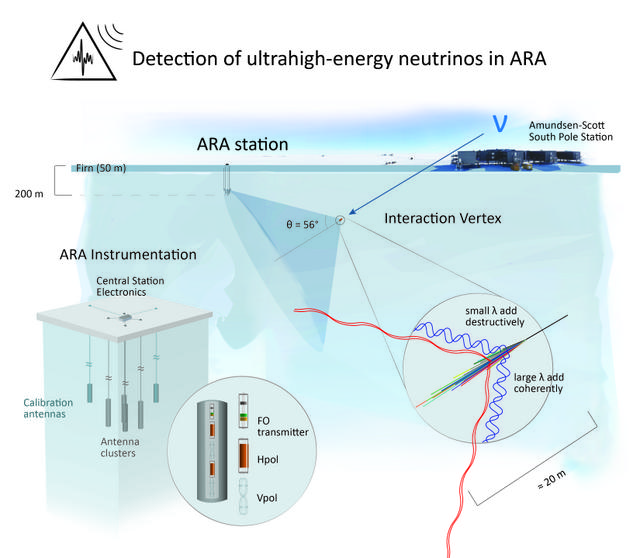
The Askaryan Radio Array (ARA) is a new detector deployed at the South Pole designed to detect high energy Neutrinos using radio-frequency signal.
Status
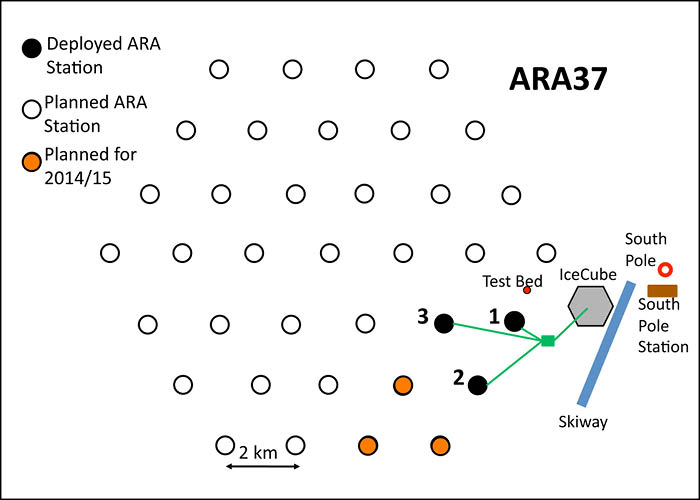
The 2012-2011 pole season has started, and ARA scientists are at the pole preparing for the installation of the next phase - "ARA1". Check Mike Duvernois' blog for current status, recent news, and many great photos.In the 2010-2011 austral summer a prototype we refer to as "The test bed" was deployed about 1km away from the South Pole station with antennas down to 30m deep. It is sucessfully taking data as you read. We are now preparing for installation of additional stations in the coming winter. Stay tuned for more information on the installation and status starting December 2011 !!! A proposal for a ~200km2 array is under preparation.
The Science
Why do we it? People have always been curious about the celestial objects surrounding us, the cosmos, and different phenomena that originate outside the Earth's atmosphere, using bare eyes and later telescopes to make observations and measurements. "Classical" telescope uses visible light (Photons) to make observations. Other telescopes use Photons in different energy ranges (like X-ray or gamma-rays) to gather complementary information. Neutrinos are a new exciting way of looking into space.Cosmic Rays are a constant "Rain" of energetic particles (like Protons) that surrounds us. Their source and how they were become so energetic are unknown. Neutrinos detected by ARA can reveal some of the misteries concerning the Cosmic Rays acceleration and propgation.
Click here if you want to learn more about the science of ARA
The detector
Neutrinos usually pass smoothly through matter without stopping or interacting. This "low cross section" makes them an excellent messenger from deep space, but also makes their detection very rare. Therefore a huge, radio-transparent and radio-quite detector is needed. The abundance of Antarctic ice, its natural transparency to radio frequencies and the isolation of the South Pole station makes Polar ice an excellent detection and interaction medium for a neutrino astrophysics. This idea was first suggested by Gusev and Zheleznyk in 1983, and was tested since in smaller scale detectors. You can learn more about the design of ARA here.
The Collaboration
ARA is a collaborative effort of several universities world wide. Our scientists are spread over 8 different time zones and speaking more than 10 different native languages. Click here if you want to learn more about us.